老司机
乌克兰独立日收到71亿大礼包,欧盟力挺乌克兰,防空导弹弹药管够,止戈军是我,原创 乌克兰独立日收到71亿大礼包,欧盟力挺乌克兰,防空导弹弹药管够_我的网站

一 |
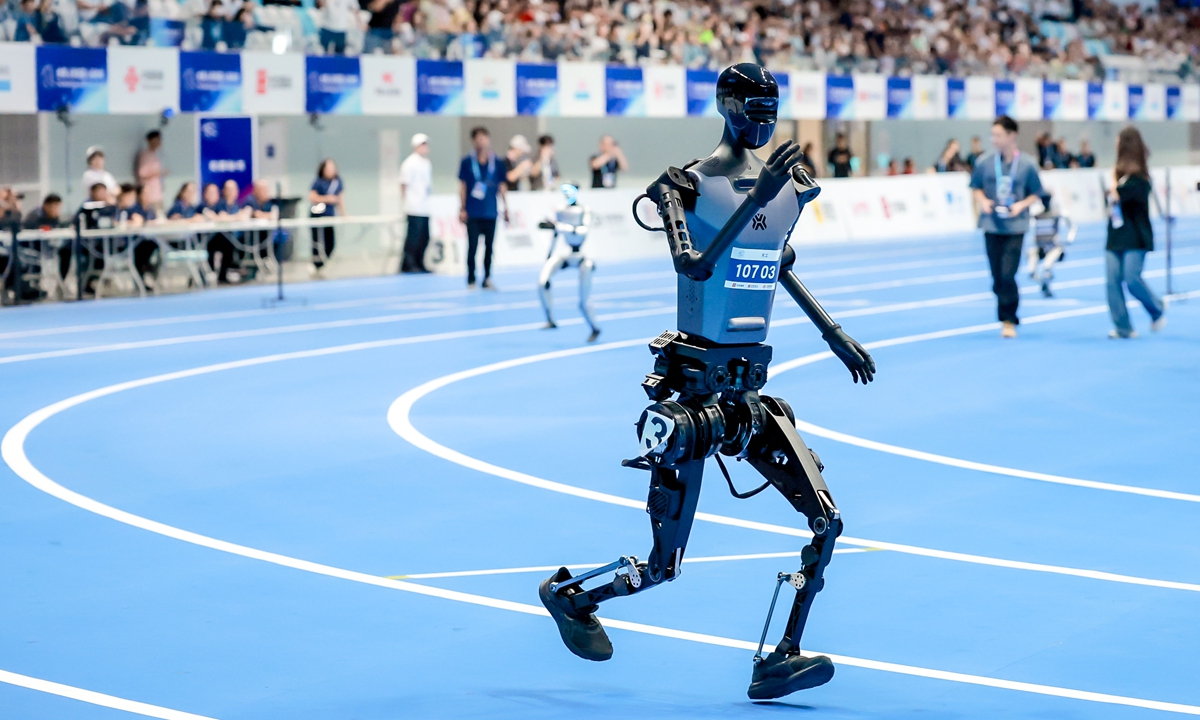
A TienKung robot competes at the first World Humanoid Robot Games. File photo: Courtesy of X-HumanoidWith the 2nd World Humanoid Robot Games (WHRG) set to open on Saturday in Beijing, organizers have unveiled a dedicated "Robot Home" to ensure that the mechanical athletes are fully charged and competition-ready.
The Games, to last until August 26, are drawing 666 teams and 2,056 robots from 16 countries and regions across six continents, underscoring the event's growing scale and influence in the global humanoid robotics sector, according to Chinese industry experts on Sunday.
A key feature this year is the newly established "Robot Home," an on-site support center designed to function much like an athletes' village for human competitors.
The facility can house more than 1,500 robots and charge at least 1,200 batteries, while enabling digital check-in and retrieval for a single robot in just 30 seconds, according to reports by China Central Television (CCTV) Finance on Sunday.
This marks a clear shift from a simple technology showcase to a more mature, competition-grade event, one analyst said. With robots now being managed through systems similar to industrial asset management - covering storage, dispatch, maintenance and safety monitoring - the Games are increasingly seen as a practical testbed for the commercialization of humanoid robotics.
According to CCTV Finance, the Robot Home will act as the football training and competition base for robots.
For team events like football, the organizing committee often provides the robot bodies, and just a few steps away is the energy recharging station.
At the station, the batteries offered by the organizing committee are charged in advance in the power cabinets, with each compartment equipped with a corresponding power strip.
The Games will also feature a "Robot Street," with activities such as intelligent retail, virtual reality viewing, and robot-operated cafes, providing a richer technology experience for both participating guests and spectators.
It will also provide an interference-resistant and highly reliable competition environment, achieving 5G+Wi-Fi converged communications.
According to the CCTV report, the event organizer has also developed the world's only competition command system specifically designed for robot events, along with an embodied intelligent robot management platform that enables the management of robots across different brands and models.
An analyst said the focus of this year's Games is shifting from whether robots can finish a course to whether they can actually perform tasks.
"Last year it was about whether they could run to the finish line. This year it's about whether they can get the job done," Wang Peng, an associate research fellow at the Beijing Academy of Social Sciences, told the Global Times.
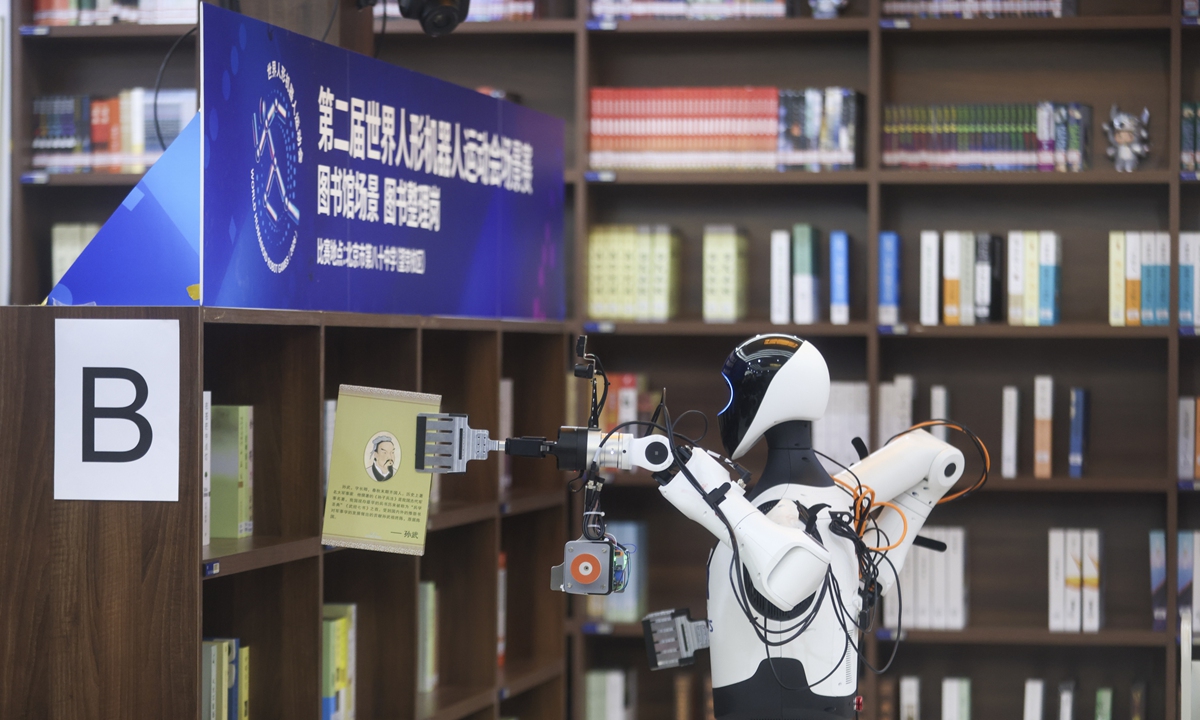
A humanoid robot inspects a bookshelf during a library scenario competition at the 2nd World Humanoid Robot Games in Beijing on August 16, 2026. Photo: VCGSome scenario-based events began their preliminaries on Sunday.
Centered on real-world applications, the scenario competition, one of this year's highlights, is designed around practical needs, with long-process tasks built on complete business logic to test humanoid robots' coordination and operational capabilities in real, complex environments, according to the organizers.
At a real firehouse in Beijing on Sunday, humanoid robots took part in a simulated firefighting mission, testing their ability to detect hazards, operate equipment and respond to emergency scenarios.
Meanwhile, several participating teams were seen in the final sprint of preparation, gearing up for competitions across diverse scenarios such as home services, industrial manufacturing, and emergency rescue.
At the industrial ecosystem training and evaluation base inside the National Speed Skating Oval, robots entered intensive preparation for office-scenario events.
In one challenge, robots must autonomously complete tasks such as loading printers, arranging meeting supplies and operating a paper shredder within 20 minutes. Any mistake or delay can affect the final score, staff at the venue explained.
Compared with the inaugural edition, the number of participating teams has increased by 138 percent, underscoring the rapid expansion of humanoid robotics as the technology moves from showcase demonstrations toward practical application.
This year's Games will run for five days and feature 51 events in total, including 30 competitive events such as ball games and confrontation contests, as well as 21 scenario-based events covering industrial assembly, home services and emergency rescue.
The planned 51 events span competitive, scenario-based and dexterous hand categories, which will reflect gains in motion control, perception-based decision-making and fine control, Chen Jing, a vice president of the Technology and Strategy Research Institute, told the Global Times on Sunday.
The competition has been significantly expanded in both scale and realism.
Scenario-based contests will take place in environments modeled on factories, hotels, homes and logistics facilities, with tasks including assembly, housekeeping, rescue operations and book sorting designed to test robots' ability to perform useful work in demanding conditions, according to reports from the Xinhua News Agency.
For the first time, the Games will establish a dedicated dexterous hand competition, which includes eight high-precision events, all drawn from real industrial production and everyday life scenarios.
A representative from AGILINK, the officially certified dexterous-hand equipment provider, told the Global Times on Sunday that winning the dexterous hand competition certifies a product's capability and means it has cleared the "demonstration-grade" threshold for real-world use.
The event is better understood as an incubator of industry consensus, Chen said, adding that competition first identifies the testing methods that Chinese and foreign firms both accept, which can then evolve toward international standards.
With robots now being managed through systems resembling industrial asset management, including storage, dispatch, maintenance and safety monitoring, the Games are increasingly seen not merely as a technology exhibition, but as a practical testing platform for the commercialization of humanoid robotics, according to Wang.
As the competition opens, the key question may be less about who wins medals and more about which robots, and which companies behind them, will be able to turn those medals into marketable orders, Wang noted.
。 2026年8月24日,欧盟委员会(European Commission);综合《基辅独立报》(Kyiv Independent)、法国《费加罗报》(Le Figaro)等多家媒体报道,欧盟批准70亿美元国防贷款,作为乌克兰独立日献礼。 在乌克兰独立日当天,欧盟委员会宣布批准一项价值61亿欧元(约合71.2亿美元) 的国防贷款,用于乌克兰采购防空系统、导弹、弹药和雷达。欧盟委员会主席乌尔苏拉·冯德莱恩在声明中表示:“在俄罗斯加强攻击之际,我们正加大力度帮助乌克兰保护其人民和捍卫领空”。 贷款来源与背景 这笔资金来自欧盟此前批准的900亿欧元“乌克兰支持贷款”,其中600亿欧元(约700亿美元)专门用于国防采购。欧盟及成员国自2022年以来已向乌克兰提供总计2202亿欧元的全面支持,其中38亿欧元来自冻结的俄罗斯资产收益。 这也是欧盟在2024年4月最终确定的贷款框架下,向基辅提供的又一批关键资金。2026年,该贷款中约有283亿欧元(约330亿美元) 被划拨用于国防采购。本次批准的61亿欧元,是在此前已批准的160亿欧元采购计划基础上的追加,其中85亿欧元已实际支付。 使用限制与采购流程 该贷款附带“本地化采购”要求:国防产品总价值的至少65% 必须来自欧盟、乌克兰或挪威。

二 | 若低于此标准,需申请豁免——乌克兰曾在2026年4月成功申请豁免,用于采购中国制造的无人机部件。此前,前国防部长米哈伊洛·费多罗夫提交了九份采购清单,其中七份已获批准。剩余两项请求包括使用欧盟资金采购美制“爱国者”拦截弹,预计未来数周内会有决定。已获批清单中包含欧洲制造的反导能力,可能包括法意SAMP/T防空系统。 各方反应与战略意义 乌克兰外长安德烈·西比哈在社交媒体上表示:“我们确切知道谁是我们真正的朋友”。欧盟理事会主席安东尼奥·科斯塔和英国首相安迪·伯纳姆等欧洲领导人于独立日当天访问基辅。 这笔援助凸显欧盟已成为乌克兰最大的军事供应方与伙伴。在美国特朗普政府基本停止对乌国防援助的背景下,欧盟的持续支持对乌克兰抵御俄军每日导弹和无人机攻击至关重要。

三 | 在乌克兰“爱国者”拦截弹严重短缺的当下,这批资金的注入无疑是一场“及时雨”。返回,查看更多。
Current article:http://sjocd.linxiuhuaishuangniuzhenrua.bond/m6qjon/20260826/36358.html
Published on:04:28:46